Vegetarian In Boston
Maynard S. Clark's Veggie and Boston Blog talks about vegetarian topics AND Boston-related topics, often intersecting them interestingly.
Maynard S. Clark is a long-time and well-known vegan in Greater Boston, who often quips in his 'elevator pitch':
"I've been vegan now for over half my natural life, longer than most human earthlings have been alive."
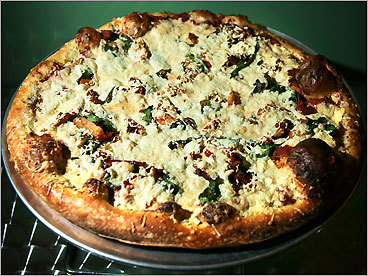
Peace o’ Pie As we step into the tiny storefront home of Peace o’ Pie pizzeria in Allston, we are enveloped by the aromas of cheesy, tomatoey goodness. Gorgeous, bubbly-crusted pizzas occupy diners at nearly every shiny table. Walls in avocado green frame the scene. Behind the bamboo counter, a young chef scoops tantalizing pies from the oven. In short, everything about the place looks and smells like a regular, trendy pizzeria, but the ingredient list is far from standard. Peace o’ Pie is scrupulously vegan.
I'm celebrating October 25 - 31 - which is World Go Vegan Week, by sharing it with others enthusiastically.
Please join us in the celebration... and go vegan, if you haven't already
http://www.worldgoveganweek.com/
“I chose to be vegan initially as an energetic pursuit, as meat and dairy slowed me down, but have since become convinced that it is not only the most healthy way to live, but also the most compassionate and ecologically responsible way.”
-Woody Harrelson, World Go Vegan Week Supporter
World GO VEGAN Week Celebrate Compassion... The 4th annual World GO VEGAN Week is taking place this year from October 25 through 31. This week is a celebration of compassion and a time to take action for animals, the environment and everyone’s well-being. We encourage people to use this week to use this week to educate their community about the vegan lifestyle as a compassionate, sustainable, and healthy way of eating and living. Promoting veganism through outreach events and the media, we know that our annual World GO VEGAN Week is helping make the word "vegan" a household word, universally recognized as meaning love and compassion for all living beings. World GO VEGAN Week is also about celebrating what it means to be vegan. Veganism enables people to live in balance with all of Earth's creatures and promote freedom from exploitation for animals as part of their everyday lives. Modern animal agriculture is cruel and violent toward the chickens, cows, pigs and other creatures used to make meat, milk and eggs. During World GO VEGAN Week, we encourage people to become conscious of what - and who - they are eating, the effect it has on the world, and that a non-violent alternative exists. We urge people to recognize the effects their actions have on the world, and our ability to actually avert some impending disasters such as global warming. For the health of people, the environment, and farmed animals, veganism is the best choice. World GO VEGAN Week embodies this idea. As an international campaign, it encourages people around the world to experience the benefits and joys of a more compassionate way of life. Here are some ways you can celebrate World GO VEGAN Week:
Be sure to register your event with us so we can send you flyers, posters and other materials to make you event a success. Contact Hope Bohanec: hope@idausa.org (415)448-0048 ex. 208.
Plan an event or activity to get people interested in veganism, such as a public lecture, cooking demonstration, feed-in with vegan food samples, leafleting, tabling, library exhibit, or street theater performance. If you serve vegan food at your event, you can get refunded for the cost through the VegFund.
Contact your local paper and encourage them to publish vegan recipes or a vegan article. We have a “editor’s pack” that you can send to your local newspaper with information and vegan recipes. Contact Hope Bohanec, hope@idausa.org, to have it sent to you.
Host a vegan potluck dinner or restaurant outing to show your family and friends that they don't have to sacrifice taste to save animals' lives. Sharing delicious vegan food with others is a fun and easy way to make a difference in the lives of animals and the people you care about.
Ask your local natural foods store to offer vegan samples for the week. Ask your favorite local food store to offer vegan samples or specials for the last week of October. Let them know that we can send information, posters and materials to help them celebrate World Go Vegan Week.
Ask veg-friendly restaurants to offer discounts or specials on their vegan food. Encourage restaurants to have vegan specials for the week or to offer a discount for bringing in a veg-curious customer.
Host a screening of Fowl Play, an eye-opening documentary about the egg-industry, at your local library or another venue. Fowl Play illuminates the plight of factory-farmed laying hens through interviews with people who are fighting diligently to save them. Invite To get a copy of Fowl Play, contact IDA at (415) 448-0048 ext. 208 or hope@idausa.org.
Host a vegan pie-baking contest. You can do this in your own home in a public place. Offer prizes like gift certificates to veggie restaurants or IDA T-shirts. Don't you want to be a judge? Yum!
Host a Vegan Halloween Party. Have a costume party and have prizes for the best animal costume, most compassionate, and the most vegan creative! Have vegan Halloween candy and treats on hand and go trick-or-treating, offering folks at the door vegan candy and brochures.
Students: join or start a vegan club in your school and plan an event with your friends that will educate people about the benefits of a vegan diet to human health, animals, and the environment. Write a paper on veganism, hand out vegan literature at a college campus or help get vegan meals into your school's cafeteria. Visit Choice to learn how.
Have a well-known vegan author or athlete come speak in your community. Host an event where a famous vegan offers an inspiring presentation. Have vegan treats for folks to try. IDA can help you contact the person.
Send a friend or family member who lives far away a gift certificate to a restaurant in their own town. Visit Happy Cow for reviews of vegetarian restaurants around the country.
Encourage meat-eating family and friends to try Meat Out Monday and give meatless meals a try for one day a week. If they sign up for the newsletter, they get reminders, recipes and inspriation in a weekly newsletter. Go to: www.meatoutmonday.org.
Write a letter to the editor about the benefits of a vegan diet or the cruelties of factory farming, or ask your local newspaper to write a story on the subject.
If you are religious, or participate in spiritual services or gatherings, look for opportunities to incorporate the vegan message into the discussions. If you participate in study groups, suggest discussion fo the vegan message.
Enter cooking competitions and bake sales using vegan recipes. Emphasize the fact that you didn't use any animal ingredients to make your delicious dishes. Attend cooking competitions and support the vegan entries.
Visit a farmed animal sanctuary and take a friend who still eats meat. There are a number of farmed animal sanctuaries where you can visit rescued cows, pigs, turkeys, chickens, ducks, goats, sheep and rabbits live naturally in peace and harmony without fear of abuse or slaughter. Check out Animal Acres, Animal Place, Farm Sanctuary, Poplar Springs Animal Sanctuary, or IDA's Project Hope.
Order t-shirts, bumper stickers, posters, pins and other fun stuff to have for the day of your event from IDA and other vegan merchants.
Join or start a vegan dinner club. Find veg-friendly restaurants and invite the community for dinner. Try a different restaurant every month.
Encourage a Compassionate Thanksgiving. Since Thanksgiving is coming up in a few weeks, talk to your community food banks about providing vegan options such as Tofurkys. Consider buying a few Tofurkys, preparing them, and bringing them to your food bank or other similar community dinner. Be sure to check out Gentle Thanksgiving which offers a lot of information and guidance on this special observance.
Share the ideals of veganism with your community of friends and colleagues by adding this quote to your email signature:
"Veganism gives us all the opportunity to say what we 'stand for' iin life -- the ideal of healthy, humane living. Add decades of health to your life, with a clear conscience as a bonus." - Donald Watson
If you are a part of an animal protection organization, become a presenter of World GO VEGAN Week. There are no costs to you for joining us as a co-presenter. All you need is to post the World GO VEGAN Days banner on your web site, which links to the World GO VEGAN Days web page. Contact Hope Bohanec, for more information: hope@idausa.org or call (415) 448-0048 ext. 208.
Downed calves: direct result of the dairy industry.
Popular utilitarian welfarist group, Vegan Outreach, maintains that in order to help non-human animals now, we must adopt a strategy which aims to reduce suffering, regardless of means. However, there are critical inconsistencies, misconceptions, and outright misuses of terminology which undermine any real benefit to non-human animals. Despite their self-designation as a “[…] nonprofit organization dedicated to reducing animal suffering by promoting a vegan lifestyle,” Vegan Outreach in fact hinders veganism with notions of extremism and promotion of reductionism or vegetarianism.
Veganism as Extremist
Vegan Outreach states in their 2009 “Why Vegan” pamphlet:
Being vegan isn’t about being perfect or pure—it’s about reducing suffering (14).
The 2002 version states:
Being vegan isn’t about avoiding a list of ingredients […] (14).
The 2008 Guide to Cruelty-Free Eating furthers that veganism can be difficult:
[…] especially if you try to change too fast or hold yourself to too high a standard. The important thing is to do the best you can (30).
It’s a good thing that society doesn’t hold the same low standards for rapists. It would be great news for molesters everywhere if they could avoid moral obligations by simply doing the best they can.
Remember: Continuing to eat cheese while avoiding meat and eggs does much more good than scrapping the whole idea because you can’t be completely consistent (Guide to Cruelty-Free Eating 30).
The implication in the above quotes is that veganism is somehow difficult, unobtainable, militant, or even utopian. Rather than defining veganism as a moral refusal to participate in violence or the absolute baseline required for taking the exploitation and use of non-human animals seriously, veganism, is instead framed as one of many opportunities for reducing suffering. In effect, this statement refutes the moral necessity of veganism and opens the door to reductionism. If veganism isn’t about being perfect or pure, what’s the harm in sneaking a donut with your morning coffee?
Sneaking that whey-tainted donut might be acceptable for Vegan Outreach:
For instance, it can be prohibitively expensive and time-consuming to shun every minor or hidden animal-derived ingredient. More importantly, avoiding an ever-increasing list of these ingredients can make us appear obsessive, and thus lead others to believe that compassionate living is impossible. This defeats our purpose: ending cruelty to animals!” (Guide to Cruelty-Free Eating 2008: 24)
Apparently having moral consistency and absolute abstinence against an evil is obsessive. Does the same go for child abuse, rape, murder, or cannibalism? Would it be acceptable to beat a child to avoid appearing obsessive? Is it impossible to completely abstain from beating a child? Of course it is, and there’s nothing obsessive about holding abstinence from violence and wrongdoing as the absolute baseline.
Vegetarianism and Reductionism as Progress
We can already see progress in just the past decade—public concern for farmed animals’ interests and condemnation of factory farms, as well as more vegetarians, near-vegetarians, and vegetarian products (A Meaningful Life: Making a real Difference in Today’s World 2008: 14)
Is reductionism and vegetarianism really progress? Is the underlying moral injustice being addressed if we continue to participate in non-human animal use? Is the focus on factory farms and the ignoring of exploitation in “humane” farming progress?
Despite the organization’s name, “Vegan” Outreach, the organization is merely an animal advocacy organization which utilizes veganism as one of many tools to reduce suffering:
In order to prevent the most suffering, it’s important we each take an approach we can sustain. After reviewing this booklet, some people may decide to go vegan immediately; others may choose to eat fewer animal products and explore more vegetarian meals. […] …veganism is best viewed as a tool for reducing suffering (Why Vegan 2009: 14).
The notion of veganism, vegetarianism, and reductionism as mere tools is perhaps most evident in their publication and distribution of the “Try Vegetarian!” pamphlet:
[…] eating vegetarian is likely the most effortless—and enjoyable!—way to have a profoundly positive impact as often as every day” (Try Vegetarian 2003).
As an organization that openly advocates vegetarianism, is it really appropriate to operate under the name, “Vegan Outreach?”
Vegan Outreach’s 2008 “Guide to Cruelty-Free Eating,” intended for meat eaters, vegetarians, and vegans alike, presents a results-based approach:
When you first discover the reality of modern animal agriculture, avoiding all producers from factory farms might seem too big a change. But don’t be overwhelmed—just take small steps. For example, you could eliminate meat from certain meals or on certain days. As you get used to eating less meat and find alternatives you enjoy, it may become easier to eliminate meat altogether (Guide to Cruelty-Free Eating 2008: 3).
As a vegan outreach organization, it seems strange that veganism is not promoted as a baseline, but here, reductionism is suggested to be morally acceptable and consistent. Furthermore, this statement specifically targets factory farming. Support of “humane” farming, then, could logically be assumed by readers to constitute a “small step.” After all, it’s all about reducing suffering, right?
Ultimately, living with compassion means striving to maximize the good we accomplish, not following a set of rules or trying to fit a certain label. From eating less meat to being vegan, our actions are only a means to an end: decreasing suffering (Guide to Cruelty-Free Eating 2008: 3)
Can reduction of suffering ever truly be accomplished and can abolition of non-human animal use ever be reached so long as so-called vegan organizations maintain that the exploitation of non-human animals is sometimes acceptable?
For every person you persuade to become vegetarian, dozens of farmed animals will be spared from suffering each year! (A Meaningful Life 2008: 23)
The argument that vegetarianism somehow makes a real difference for non-human animals is an empirical fallacy. There is no continuum whereby vegetarians necessarily progress to veganism. Further, vegetarianism does nothing to challenge the property status of non-human animals. Often, vegetarianism causes more suffering than it reduces in that many vegetarians simply replace non-human animal flesh with non-human animal excretions. Milk, eggs, and other non-flesh non-human animal products involve far more suffering than that of flesh.
Veganism as the Moral Baseline
Vegan Outreach posits:
The question isn’t, “Is this vegan?” but, “What is best for preventing suffering?” (Guide to Cruelty-Free Eating 3)
The answer to that question is: “GO VEGAN.” Veganism is the only moral choice if we truly want to reduce suffering, respect the moral standing of non-human animals, and ultimately reach total abolition of non-human animal use. There’s nothing hard about it, there’s nothing obsessive about it, and there’s nothing inconsistent about it. More About: abolition· animal rights· welfarism
Downed calves: direct result of the dairy industry.
Popular utilitarian welfarist group, Vegan Outreach, maintains that in order to help non-human animals now, we must adopt a strategy which aims to reduce suffering, regardless of means. However, there are critical inconsistencies, misconceptions, and outright misuses of terminology which undermine any real benefit to non-human animals. Despite their self-designation as a “[…] nonprofit organization dedicated to reducing animal suffering by promoting a vegan lifestyle,” Vegan Outreach in fact hinders veganism with notions of extremism and promotion of reductionism or vegetarianism.
Veganism as Extremist
Vegan Outreach states in their 2009 “Why Vegan” pamphlet:
Being vegan isn’t about being perfect or pure—it’s about reducing suffering (14).
The 2002 version states:
Being vegan isn’t about avoiding a list of ingredients […] (14).
The 2008 Guide to Cruelty-Free Eating furthers that veganism can be difficult:
[…] especially if you try to change too fast or hold yourself to too high a standard. The important thing is to do the best you can (30).
It’s a good thing that society doesn’t hold the same low standards for rapists. It would be great news for molesters everywhere if they could avoid moral obligations by simply doing the best they can.
Remember: Continuing to eat cheese while avoiding meat and eggs does much more good than scrapping the whole idea because you can’t be completely consistent (Guide to Cruelty-Free Eating 30).
The implication in the above quotes is that veganism is somehow difficult, unobtainable, militant, or even utopian. Rather than defining veganism as a moral refusal to participate in violence or the absolute baseline required for taking the exploitation and use of non-human animals seriously, veganism, is instead framed as one of many opportunities for reducing suffering. In effect, this statement refutes the moral necessity of veganism and opens the door to reductionism. If veganism isn’t about being perfect or pure, what’s the harm in sneaking a donut with your morning coffee?
Sneaking that whey-tainted donut might be acceptable for Vegan Outreach:
For instance, it can be prohibitively expensive and time-consuming to shun every minor or hidden animal-derived ingredient. More importantly, avoiding an ever-increasing list of these ingredients can make us appear obsessive, and thus lead others to believe that compassionate living is impossible. This defeats our purpose: ending cruelty to animals!” (Guide to Cruelty-Free Eating 2008: 24)
Apparently having moral consistency and absolute abstinence against an evil is obsessive. Does the same go for child abuse, rape, murder, or cannibalism? Would it be acceptable to beat a child to avoid appearing obsessive? Is it impossible to completely abstain from beating a child? Of course it is, and there’s nothing obsessive about holding abstinence from violence and wrongdoing as the absolute baseline.
Vegetarianism and Reductionism as Progress
We can already see progress in just the past decade—public concern for farmed animals’ interests and condemnation of factory farms, as well as more vegetarians, near-vegetarians, and vegetarian products (A Meaningful Life: Making a real Difference in Today’s World 2008: 14)
Is reductionism and vegetarianism really progress? Is the underlying moral injustice being addressed if we continue to participate in non-human animal use? Is the focus on factory farms and the ignoring of exploitation in “humane” farming progress?
Despite the organization’s name, “Vegan” Outreach, the organization is merely an animal advocacy organization which utilizes veganism as one of many tools to reduce suffering:
In order to prevent the most suffering, it’s important we each take an approach we can sustain. After reviewing this booklet, some people may decide to go vegan immediately; others may choose to eat fewer animal products and explore more vegetarian meals. […] …veganism is best viewed as a tool for reducing suffering (Why Vegan 2009: 14).
The notion of veganism, vegetarianism, and reductionism as mere tools is perhaps most evident in their publication and distribution of the “Try Vegetarian!” pamphlet:
[…] eating vegetarian is likely the most effortless—and enjoyable!—way to have a profoundly positive impact as often as every day” (Try Vegetarian 2003).
As an organization that openly advocates vegetarianism, is it really appropriate to operate under the name, “Vegan Outreach?”
Vegan Outreach’s 2008 “Guide to Cruelty-Free Eating,” intended for meat eaters, vegetarians, and vegans alike, presents a results-based approach:
When you first discover the reality of modern animal agriculture, avoiding all producers from factory farms might seem too big a change. But don’t be overwhelmed—just take small steps. For example, you could eliminate meat from certain meals or on certain days. As you get used to eating less meat and find alternatives you enjoy, it may become easier to eliminate meat altogether (Guide to Cruelty-Free Eating 2008: 3).
As a vegan outreach organization, it seems strange that veganism is not promoted as a baseline, but here, reductionism is suggested to be morally acceptable and consistent. Furthermore, this statement specifically targets factory farming. Support of “humane” farming, then, could logically be assumed by readers to constitute a “small step.” After all, it’s all about reducing suffering, right?
Ultimately, living with compassion means striving to maximize the good we accomplish, not following a set of rules or trying to fit a certain label. From eating less meat to being vegan, our actions are only a means to an end: decreasing suffering (Guide to Cruelty-Free Eating 2008: 3)
Can reduction of suffering ever truly be accomplished and can abolition of non-human animal use ever be reached so long as so-called vegan organizations maintain that the exploitation of non-human animals is sometimes acceptable?
For every person you persuade to become vegetarian, dozens of farmed animals will be spared from suffering each year! (A Meaningful Life 2008: 23)
The argument that vegetarianism somehow makes a real difference for non-human animals is an empirical fallacy. There is no continuum whereby vegetarians necessarily progress to veganism. Further, vegetarianism does nothing to challenge the property status of non-human animals. Often, vegetarianism causes more suffering than it reduces in that many vegetarians simply replace non-human animal flesh with non-human animal excretions. Milk, eggs, and other non-flesh non-human animal products involve far more suffering than that of flesh.
Veganism as the Moral Baseline
Vegan Outreach posits:
The question isn’t, “Is this vegan?” but, “What is best for preventing suffering?” (Guide to Cruelty-Free Eating 3)
The answer to that question is: “GO VEGAN.” Veganism is the only moral choice if we truly want to reduce suffering, respect the moral standing of non-human animals, and ultimately reach total abolition of non-human animal use. There’s nothing hard about it, there’s nothing obsessive about it, and there’s nothing inconsistent about it. More About: abolition· animal rights· welfarism
Feeling sluggish?
Catching frequent colds?
Considering shedding a few pounds?
Want to help protect the environment and reduce global warming?
Troubled by animal suffering in factory farms and slaughterhouses?
Sounds like you're ready for Meatout Mondays!
Meatout Mondays is a colorful weekly e-mail newsletter that delivers a delicious veg recipe, product suggestion, health news, and an inspiring story. Sign-up today and your first recipe will be sent this Friday (so you have time to get ready for Monday).
Want more? When you sign-up, you can also request your FREE Veg Starter Kit, a 32-page full-color magazine with details about the benefits of "kicking the meat habit" and helpful information on how to make the switch. This is your opportunity to make a difference at every meal... a choice to improve your health, protect the environment, reduce global hunger, and save animals. Can't wait? Check out our past issues and 7-days worth of recipes to start. Thank you for caring. Together, we are making better choices for a better world.
Meatout Mondays is proudly sponsored by:
A Campaign of FARM 10101 Ashburton Lane Bethesda, MD 20817 888-FARM-USA (327-6872) . email us
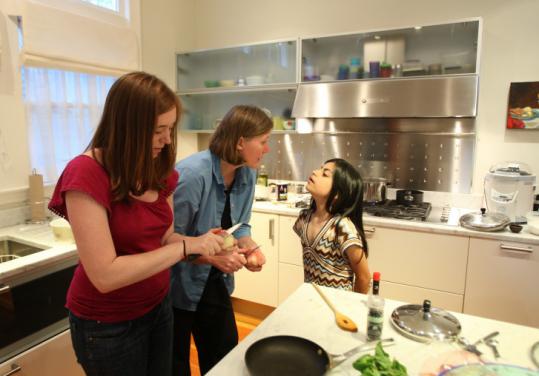
Lisa Landsverk and her daughters Rachael (left) and Teymura are among the new inhabitants of Julia Child's former house.
(Essdras M Suarez/ Globe Staff)
By Billy BakerGlobe Correspondent / August 31, 2009
CAMBRIDGE, Massachusetts, USA -
They are known for their love of cats. At least they had that much in common.
But Lisa Landsverk, the new owner of the grand Victorian home on Irving Street in Cambridge where Julia Child, the doyenne of la cuisine bourgeoise, lived, cooked, and warbled for 43 years, has brought a bit of her own personality to the place.
Take the painting of the cow.
“Nobody says when I grow up I want to be a hamburger,’’ the painting’s caption reads.
Yes, the matriarch of Child’s former kitchen is an animal-rights activist and a vegetarian. “It’s a bit ironic,’’ Landsverk said, in an understatement.
What’s more, Landsverk is not what you would call a foodie. She likes to make simple things for dinner: pasta, burritos, reservations. But in the month since Landsverk and her husband, Harvard Law School professor Michael Klarman, moved into Child’s former home near the Harvard campus, they have found themselves the accidental caretakers of what has become a bit of a destination for food tourists.
Due to a recent movie about her life, “Julie & Julia,’’ everything Julia Child is hot. The film, based on a 2005 book by blogger Julie Powell about her attempt to cook all 524 recipes in Child’s landmark “Mastering the Art of French Cooking’’ in a single year, has catapulted Child, who died in 2004, back into the spotlight.
Child’s 48-year-old book has shot to the top of the bestseller list.
With the Julia mania has come an odd sort of attention for Landsverk, a former lawyer, and her family.
There are the lurkers outside their windows, snapping pictures of the house; the person who left a stick of butter (Child’s favorite ingredient) on their fence post; and the reporter who knocked on their door to ask what it’s like to cook on the site of hallowed culinary ground.
“The truth is that we haven’t done much cooking since we moved into the place,’’ Landsverk said.
After a bit of hesitation, she agreed to allow the reporter in to change that.
The plan was simple: Make a couple of Child’s recipes and see how it feels. Landsverk added one caveat: Everything had to be vegan because she did not want to offend her animal-rights friends. So, no butter.
Landsverk chose ratatouille for an entrée - she liked Child’s assertion that the eggplant casserole “perfumes the kitchen with the essence of Provence’’ - and, for dessert, pêches cardinal, a compote of fresh peaches with raspberry purée.
Helping her were daughters Rachael Klarman, 20, a junior at the University of Virginia, and 8-year-old Teymura.
A son, 17, was off at Japanese camp, and her oldest daughter, 22, was still in Charlottesville, Virginia, where the family lived before the move.
Rachael Klarman admits she had never heard of the famous chef before the realtor touted the Child connection to the family.
But she has become quite enthusiastic about the former occupant, recently reading “Julie & Julia’’ and Child’s memoir, “My Life in France.’’
As she walked back from a supply run to Savenor’s Market on a sweltering afternoon last week - Savenor’s was a favorite of Child’s, and she carved her signature signoff, “Bon Appétit,’’ into the sidewalk outside - Rachael Klarman said she’s been inspired to do more cooking in the kitchen, so that Child “is not rolling over in her grave.’’
Child and her husband, Paul, bought the house in 1956 for $35,000 and moved in two years later.
Paul, an artist and foreign service officer, designed the kitchen to Julia’s strict specifications, including countertops that were 2 inches higher than normal to accommodate her 6-foot-2-inch frame.
The kitchen was styled along the lines of a workshop, with the pots and pans hung from pegboards around the room, favorite knives - she had 800 - on magnetic strips between the windows, and everyday utensils in jars above the Garland range.
The pale green space changed little in Child’s time, and was familiar to many from the three cooking shows she filmed there during the 1990s.
When Child moved out in 2001, her kitchen and its contents were donated to the Smithsonian, where they are now an exhibit.
The house went through down-to-the-studs renovation, and when Lisa Landsverk and her family bought the 6,000-square-foot home in February for a reported $3.7 million, the only sign of Child’s tenure was her wine cellar, with its simple pine racks and handwritten vintage labels written by her husband.
The current kitchen is modern and white with a few stainless-steel accents. The windows and doorways are in the same place as when Child lived there, but the room has been expanded; an elevator has been removed to create a sunroom with a small dining area.
Stylewise, about the only thing the kitchen shares with Child’s is that everything has a place; in the new kitchen, that place is out of sight. Everything is so neatly concealed that Rachael said it took them a while to find the silverware drawer (it was hidden inside a larger drawer on the kitchen island).
With the ingredients ready and the cookbook open, Lisa and Rachael began making their way through the ratatouille recipe. Immediately, they realized that this was not going to be a quick meal.
“That’s very specific,’’ Lisa Landsverk said as she read Child’s directions to cut the eggplant into 3/8-inch-thick slices.
“No, there’s more,’’ Rachael Klarman said as she kept reading. “She calls for chunks with three specific dimensions. That’s impressive.’’
“And she wants us to dry each slice with a towel!’’ her mother gasped with a smile on her face. “We’re going to be here all day.’’
As they made their way through the recipes, mother and daughter began to notice a curious aspect to their conversation. They never said “the recipe wants’’ or “the book says;’’ they said “she says mind the heat’’ and “she wants us to chill the purée.’’ In “Julie & Julia,’’ Powell describes feeling that Julia was by her side like “some great big good fairy.’’
Lisa Landsverk and her daughter weren’t quite as grandiose, but agreed on one thing: Julia Child had them engaged with their dinner.
More than two hours after the cooking began, the kitchen was a mess but the food was ready. Teymura, who is chatty and a bit sassy, tried to get out of eating the ratatouille (she’d been pining for pasta), but relented when she was allowed to use chopsticks. She took one bite and announced “It’s kind of good, but not that good.’’
Rachael Klarman and her mother were more hesitant in their assessment.
After a few bites, Rachael said, almost relieved, “It tastes fine.’’ Her mother was impressed by the medley of flavors, but criticized her own technique.
“I think I overcooked the eggplant,’’ she said. “I wasn’t minding my heat like she said.’’
Correction: Because of an editing error, a Page One story yesterday about the owner of Julia Child's house gave the incorrect last name for the owner's daughter. Her name is Rachael Klarman.
Published Author,
Copywriter,
Grammar Guru -
50 years of helping universities, companies, nonprofits, and individuals do their work, remain organized, and develop facts and useful products and services, and in that process telling their stories with clarity and impact -- attracting revenue and donations, students and researchers, staffers at various levels, and volunteers and journalists who want to participate in those stories.
 Read the full Globe review (Denise Taylor, Globe Staff)